Written by Jonty Yamisha, Founder of OptiLingo and lifelong heritage-language learner
I wrote this guide for absolute beginners, the kind of learner I used to be when I first tried speaking French outside a classroom. I still remember standing in a tiny bakery in Lyon, practicing the word bonjour under my breath, only to hear it come out with a melody that felt more Chicago than French. The woman behind the counter understood me, but I could tell something in the rhythm sounded off. This guide will help learn French accent and will help you sound more French.
Maybe you have felt the same moment. You know the words, but the sound does not feel French yet.
Here is the good news. A French accent is not about perfection and it is not about hiding where you are from. It is simply about clarity. With a few small adjustments to rhythm, mouth shape, and key sounds, you can become easier to understand and feel more confident every time you speak.
This guide will show you the basics of rhythm, intonation, mouth position, the French R, key vowels, nasal vowels, linking, and all the accent marks you see in written French like é, è, ç, and ô. Everything is designed for A0 to A1 learners using everyday vocabulary, simple examples, and small practice drills you can repeat right away.
If you want to hear these sounds in natural speech, you can try OptiLingo free for 7 days and practise inside real audio lessons.
To learn a French accent as a beginner, listen to native audio, copy the rhythm, and practise key sounds such as é, u, nasal vowels, and the French R. Repeat short sentences daily, record yourself, compare your voice to native speech, and use slow-to-natural audio to build clarity and confidence.
Table of Contents
- Why Your French Accent Matters (and Why It Doesn’t)
- How to Use This Guide
- What Is a French Accent? Big Picture
- French Rhythm and Intonation Basics
- Mouth Position: French vs English
- The French R and Other Tricky Consonants
- Key French Vowel Sounds for Beginners
- Nasal Vowels: Air Through the Nose
- Linking and Word Groups
- A Quick Daily Practice to Sound More French
- French Accent Marks: Overview
- Accent Aigu (é)
- Accent Grave (è-à-ù)
- Accent Circonflexe (ê-â-î-ô-û)
- Tréma (ë-ï-ü)
- Cédille (ç)
- Mini Practice: Accent Marks + Sounds
- What to Do Next
- FAQs
- Keep Learning French Sounds
Why Your French Accent Matters (and Why It Doesn’t)
A foreign accent in French is natural. Everyone learning a new language has one. Your goal is not to erase your identity or mimic someone else. The real goal is to speak clearly and to be understood. If people understand your French, you have a successful French accent, even if you still sound like you are from the United States.
Certain sounds matter more for clarity. French relies on steady rhythm, a particular mouth position, a few unique vowels, gentle nasal sounds, and linking between words. When you learn these pieces, you begin to sound more French without trying to sound perfect.
The most important idea is that a French accent is a collection of small habits, not something you must “master” before speaking. You improve over time. You improve every time you say a sentence out loud. You improve every time you listen. This guide is here to help you build those habits gently and confidently.
How to Use This Guide
Here is the best way to use what you learn:
- Read each explanation slowly.
- Look at the mouth or sound description.
- Say the French examples out loud.
- Shadow the sample sentences by repeating them immediately after listening.
- Practise for only 5 to 10 minutes a day.
Accents change through muscle memory. The more often your lips, jaw, and tongue move in French patterns, the more natural the accent becomes. You do not need long study sessions. Frequent short bursts are far more effective.
OptiLingo lessons follow the same listen and repeat method, with slow and natural audio to help beginners absorb the patterns.

What Is a French Accent? Big Picture
A French accent is made of four parts:
- the sounds of the language
- the rhythm of the syllables
- the rising and falling melody
- the smooth linking between words
English uses stressed syllables, which creates strong beats and weak beats. French does not. In French, most syllables are almost equal. This gives the language its signature flow.
Try tapping your hand for each syllable:
Je vais au cinéma ce soir.
I am going to the cinema tonight.
Tap on every part:
je – vais – au – ci – né – ma – ce – soir.
The rhythm is even and steady. It might feel unusual if you grew up speaking English, but once you start hearing it, French becomes much easier to imitate.
French also uses clear intonation patterns. A statement usually falls at the end. A yes or no question usually rises at the end. This gives sentences a musical curve that is easy to recognize after some listening.
If you want more help with basic pronunciation, explore our French pronunciation guide.
French Rhythm and Intonation Basics
French rhythm is one of the biggest differences between English and French. Learning this can change the way your entire sentence sounds.
Even syllables
French does not stretch certain syllables the way English does. Every beat is close in length.
Say these slowly:
- Je mange une pomme. (I am eating an apple.)
- Nous allons à Paris. (We are going to Paris.)
- Elle arrive demain. (She arrives tomorrow.)
Keep each syllable equal. You may feel like you are speaking more slowly than usual, but this is exactly how French maintains its smooth sound.
Falling tone for statements
The melody generally falls at the end.
- Je vais au cinéma ce soir.
- Il travaille aujourd’hui.
Try saying them with a gentle downward curve at the last word.
Rising tone for yes/no questions
A simple rise at the end turns a sentence into a question:
- Tu viens ? (Are you coming?)
- Vous êtes prêts ? (Are you ready?)
More practice sentences
Try these, thinking only about rhythm and melody:
- Elle habite ici. (She lives here.)
- Tu m’entends ? (Do you hear me?)
- On commence maintenant. (We are starting now.)
Micro-Drill: Shadow the Melody
- Je suis ici.
- Tu vas bien ?
- On y va demain.

Mouth Position: French vs English
Most learners think accents are about memorizing rules, but the truth is that the mouth shapes are the real secret. French uses slightly different movements than English.
Lips
French uses rounded lips for many sounds.
Examples:
- ou in vous
- o in rose
- u in tu
To feel this, say oo, then push your lips forward just a little more. That extra rounding is French.
Tongue position
For many consonants, especially t, d, n, and l, the tongue touches the back of your top teeth, not the roof of your mouth.
Try these slowly:
- tout (all)
- deux (two)
- dix (ten)
- non (no)
You should feel your tongue meet the teeth gently.
Jaw
French often uses a slightly more forward jaw. You are not pushing your chin out, but your mouth stays a little more forward than in English. You will feel this especially with u, ou, and o sounds.
Personal note
When I started learning French, the most surprising change was how much I had to rely on my lips. English uses the tongue a lot. French uses the lips almost as much. Once I understood this, my accent improved quickly.
Micro-Drill
Say each word focusing on the tongue location and lip shape:
- tout – deux – dix – non
The French R and Other Tricky Consonants
The French R is one of the most recognizable sounds in the language. It comes from deeper in the throat than the English R.
How to produce the French R
- Relax your throat.
- Gently breathe out.
- Let the airflow vibrate near the back of your tongue.
- Start with a soft r sound like you are clearing your throat gently.
- Then try combinations: ra, ri, ru, ré.
Take your time. It might feel unfamiliar. This is completely normal.
Practice words
- Paris
- très
- rouge
- merci
- chambre
These contain different positions of the French R, from the middle of the word to the beginning and end.
Other important consonants
j → soft “zh” sound
Examples: jour, je, joli
gn → “ny” like in canyon
Examples: montagne, champagne
Silent final consonants
French often does not pronounce final letters:
- parlent (the t is silent)
- grand (the d is silent)
More practice
Try these sentences:
- Je regarde la rue rouge. (I see the red street.)
- Paris est très joli. (Paris is very pretty.)
Micro-Drill
Repeat:
- rouge – Paris – très – merci – chambre
- Je regarde la rue rouge.
Key French Vowel Sounds for Beginners
Vowels make up most of the character of a French accent. A few key vowels will help you sound more natural immediately.
a
Open and relaxed.
Examples: maman, la banque
i
A high, bright “ee” sound.
Examples: si, ville
ou
Round the lips.
Examples: vous, jour
é (closed) vs è (open)
é is like a short “ay.”
è is a more open “eh.”
Examples:
- été
- très
- père
The French u
This sound does not exist in English.
How to make it:
- Say ee.
- Keep the tongue exactly where it is.
- Round the lips like you are saying oo.
The combination of ee tongue position and oo lips creates u.
Examples:
- tu (you)
- lune (moon)
- musique (music)
Minimal pairs
These help you hear the difference:
- tu vs tout
- peu vs peau
- été vs être
Micro-Drill
Say:
tu – tout – peu – peau – été – être
Nasal Vowels: Air Through the Nose
Nasal vowels help give French its soft and warm character. They are made with gentle airflow through the nose and mouth at the same time.
There are four main patterns.
an / en
Examples:
- sans (without)
- enfant (child)
in / im / ain / ein
Examples:
- pain (bread)
- lundi (Monday)
on
Examples:
- bon (good)
- nom (name)
un
Examples:
- un (one)
- brun (brown)
These sounds should be soft, not strong or nasal like an exaggerated cartoon voice.
Classic example
Un bon vin blanc.
A good white wine.
Break it down: un – bon – vin – blanc.
Micro-Drill
Say slowly:
sans – bon – pain – maison – lundi
Linking and Word Groups
French often links sounds between words, making speech smooth and connected.
Liaison
This happens when a word ending in a consonant is followed by a vowel.
- vous_avez
- les_amis
- un_ami
Liaison is essential for sounding natural.
Word grouping
French organizes words into chunks of meaning.
Example:
Je vais / au cinéma / ce soir.
Group the words, and you will hear the rhythm more clearly.
More examples
Try grouping these:
- Nous allons / en France / en été.
- Elle parle / avec un ami.
Micro-Exercise
Say these word by word, then in groups:
- Je suis / en vacances.
- Il a / un ami / en Espagne.
A Quick Daily Practice to Sound More French
A simple daily routine can improve your accent more than anything else.
Try this:
- Choose two short sentences.
- Listen without reading.
- Listen while reading.
- Shadow the audio.
- Record yourself saying the same sentences.
- Compare your recording to the native audio.
This method builds rhythm, clarity, and confidence. Even five minutes a day can create real progress.
OptiLingo lessons use this exact listen and shadow loop, which makes them ideal for practicing French sounds.
French Accent Marks: Overview
Accent marks in French show how to pronounce certain vowels and help with spelling. They are very common and appear in everyday words.
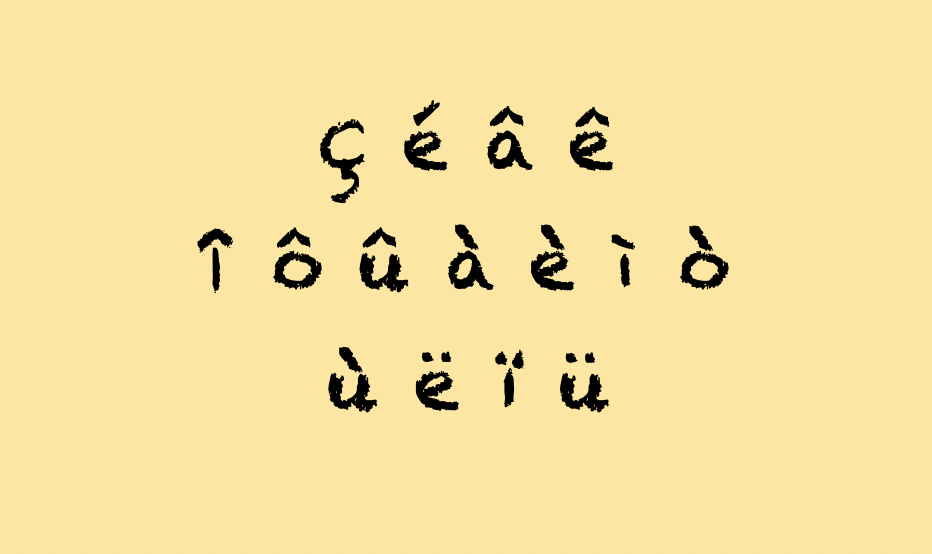
The main accent marks are:
- é (accent aigu)
- è, à, ù (accent grave)
- ê, â, î, ô, û (accent circonflexe)
- ë, ï, ü (tréma)
- ç (cédille)
At the beginner level, focus mainly on how accents change the sound of e and c. Once you understand these small changes, reading French becomes much easier.
Accent Aigu (é)
The accent aigu creates a clear, closed vowel sound.
Examples:
- café
- été
- métro
- déjeuner
- télé
Sample Sentence
Il fait beau en été.
It is nice weather in summer.
Mini-Drill
café – télé – métro – déjeuner – été
Accent Grave (è, à, ù)
The accent grave on è creates an open “eh” sound.
Examples:
- très
- père
- après
- problème
Accent grave on à and ù usually does not change pronunciation at A1. It helps distinguish words:
- a (has) vs à (to)
- ou (or) vs où (where)
Example Sentences
C’est très facile.
It is very easy.
Où est le père ?
Where is the father?
Mini-Drill
très – père – après – problème – à – où
Accent Circonflexe (ê, â, î, ô, û)
This mark often indicates a slightly longer vowel or an old missing s.
Examples:
- fête
- forêt
- hôtel
- sûr
- pâte
Sample Sentence
La fête est à l’hôtel.
The party is at the hotel.
Mini-Drill
fête – forêt – hôtel – sûr – pâte
Tréma (ë, ï, ü)
The tréma shows that two vowels are pronounced separately.
Examples:
- Noël
- naïf
- Haïti
- maïs
Micro-Drill
Noël – naïf – Haïti – maïs
Cédille (ç)
The cédille changes c from a “k” sound to an “s” sound before a, o, and u.
Examples:
- ça
- garçon
- leçon
- français
Sentences
Ça va ?
How are you?
Je suis français.
I am French.
Mini Practice: Accent Marks + Sounds
Shadow these sentences:
- C’est très facile.
- Un bon café, s’il vous plaît.
- Je suis français.
- J’aime le cinéma.
- Où est l’hôtel ?
Say them slowly. Then naturally. Then record yourself.
What to Do Next
You now know the key features of the French accent. You understand the rhythm, the tone, the mouth position, the essential vowel sounds, the nasal patterns, and the meaning of accent marks. This is more than enough to begin sounding clearer, smoother, and more confident.
The next step is to build a short daily habit.
Choose a few sentences.
Listen.
Shadow.
Record.
Compare.
Repeat.
OptiLingo follows this natural method and helps you practise inside real conversations.
Try the OptiLingo free 7 day trial to start sounding more French in your very next practice session.
FAQs
Can adults really improve their French accent?
Yes. Accent improvement is mostly muscle memory. Adults can make fast progress with short daily practice.
Do I need a perfect accent to be understood?
No. You only need clarity. A mild foreign accent is completely normal.
What are the hardest French sounds for English speakers?
The French R, the vowel u, nasal vowels, and certain intonation patterns.
How can I practise my French accent at home?
Listen, shadow, record, and repeat. Even two sentences per day helps.
How long before I hear progress?
Most people notice small improvements within one or two weeks of consistent practice.
Learn French Easily
You can master French accent marks very easily. But, how fast can you master the French language? The truth is, it doesn’t take long to reach French fluency. And with an amazing method like OptiLingo, that’s a guarantee.
OptiLingo is the language learning app that brings you results. It gives you the most common French words and phrases. So, you only learn the most useful expressions. Don’t waste time on unnecessary vocabulary ever again. Start speaking like a local today. And soon, you’ll be fluent in French without even noticing. Download OptiLingo, and discover how much more effective learning French can be!
Additional French Learning Resources