Written by Jonty Yamisha, Founder of OptiLingo, heritage-language learner, and lifelong advocate for stress-free language acquisition
When I first learned German, I remember sitting in a Berlin café pointing at a menu and quietly mouthing letters to myself. Languages feel intimidating until the symbols start making sense, and once you understand how German letters sound, the rest of the language opens up. This guide is specifically written for beginners who want to learn German alphabet without any complicated instructions or manuals.
In this guide, you’ll learn the German alphabet from A to Z, including:
- Letter names
- How each letter sounds
- Simple English approximations
- Umlauts (Ä, Ö, Ü)
- ß
- The most important letter combinations (sch, ch, ei, ie, sp, st)
- A few practice drills you can finish in minutes
The goal is simple: you’ll walk away knowing every major German sound you need at the A1 level.
Want to hear each letter inside real dialogues?
Try OptiLingo free for 7 days and learn German the natural way.
How to Learn the German Alphabet
- Learn the 26 letters plus Ä, Ö, Ü, and ß
- Practise German letter names (A = “ah,” J = “yot,” W = “veh”)
- Master tricky sounds (ch, r, ü, ö)
- Use examples like Auto, Brot, ich, ja, Zug
- Study common combos (sch = “sh,” ei = “eye”)
- Read and spell simple A1 words aloud
Table of Contents
- Intro
- How the German Alphabet Works
- A–Z Master Table
- The Trickiest German Sounds (Quick Fixes)
- Umlauts & ß Explained
- Common Letter Combos
- Mini Practice
- What to Learn Next
- FAQs

1. What You’ll Learn Today
German uses the same basic 26 letters you already know from English, plus a few bonus characters: Ä, Ö, Ü, and ß. The good news? Once you learn their names and sounds, German spelling becomes extremely predictable. Far more predictable than English, honestly.
This guide walks you through every single letter with:
- A clear table of names, sounds, approximations, and examples
- Tips for the sounds English speakers struggle with most
- Short drills you can do out loud
- Explanations of umlauts and letter combinations
- Practical examples you’ll actually use at A1 level
As someone who has spent years helping beginners break through early pronunciation anxiety, I can tell you, if you learn these sounds now, everything gets easier.
Want to hear each letter inside real sentences?
Try OptiLingo free for 7 days.
2. How the German Alphabet Works
The German alphabet has:
- 26 standard letters (A–Z)
- 3 umlaut vowels: Ä, Ö, Ü
- 1 special consonant: ß (Eszett)
You’ll notice two big differences from English:
1. Letter names
German letter names sound different (e.g., “J” = yot, “W” = veh).
Learning these helps with spelling your name, giving your email to a hotel, or ordering something politely.
2. Sounds are consistent
Unlike English, German letters usually have one reliable sound, especially at the A1 level. There are exceptions (like “s” and “v”), but we’ll cover them clearly.
A simple way to think about it:
- Vowels carry the melody of the word
- Consonants give the structure
Once you combine them, German pronunciation starts to feel logical and even satisfying.
For deeper help with pronunciation, see our German pronunciation guide.
3. A–Z Master Table
Below is your complete German alphabet with:
- Letter
- German name
- Simplified sound
- English approximation
- A1-friendly example
- Meaning
German Alphabet Table (A–Z + special letters)
Letter |
German name |
Key sound (simplified) |
English approximation |
Example (DE) |
Meaning |
A |
a |
ah |
a in father |
Apfel |
apple |
B |
be |
b |
b in bat |
Brot |
bread |
C |
ce |
k (before a/o/u) |
k in cat |
Computer |
computer |
D |
de |
d |
d in dog |
Dorf |
village |
E |
e |
ay / eh |
“eh” sound |
Esel |
donkey |
F |
ef |
f |
f in fun |
Fisch |
fish |
G |
ge |
g |
g in go |
gut |
good |
H |
ha |
h |
h in hat |
Haus |
house |
I |
i |
ee |
ee in see |
Igel |
hedgehog |
J |
jot |
y |
y in yes |
ja |
yes |
K |
ka |
k |
k in kite |
Kind |
child |
L |
el |
l |
l in love |
Lampe |
lamp |
M |
em |
m |
m in man |
Mama |
mom |
N |
en |
n |
n in no |
Name |
name |
O |
o |
oh |
o in go (pure) |
Oma |
grandma |
P |
pe |
p |
p in pen |
Park |
park |
Q |
ku |
kv |
“k + v” together |
Quelle |
spring / source |
R |
er |
French-like r |
back-of-throat r |
rot |
red |
S |
es |
z (before vowels) |
z in zoo |
Sonne |
sun |
T |
te |
t |
t in tea |
Tisch |
table |
U |
u |
oo |
oo in moon |
Uhr |
clock |
V |
vau |
f |
f in far |
Vater |
father |
W |
we |
v |
v in van |
Wasser |
water |
X |
iks |
ks |
ks in box |
Taxi |
taxi |
Y |
ypsilon |
ü-like |
French u |
Typ |
type/guy |
Z |
zett |
ts |
ts in cats |
Zeit |
time |
Ä |
ä |
eh |
e in bed |
Mädchen |
girl |
Ö |
ö |
er-rounded |
like “er” with rounded lips |
schön |
beautiful |
Ü |
ü |
ee-rounded |
“ee” with rounded lips |
grün |
green |
ß |
eszett |
s |
s in see |
Straße |
street |
Quick tip:
- S can be z-like (Sonne), or s-like (Haus).
- V is usually f.
- W is always v.
These patterns become automatic with practice.

-
-
4. The Trickiest German Sounds
Every English speaker struggles with the same small group of sounds. Here is how to fix them quickly, without overthinking things.
1. The German R (back-of-the-throat “r”)
German uses a softer, uvular-style R.
Mouth tip: Relax your tongue. Keep it low. Let the sound come from the back of your throat, not the front.Example:
- rot (red)
It doesn’t need to be perfect, even Germans pronounce it differently across regions.
2. CH, two different sounds
This one looks scary but obeys a simple rule:
After front vowels (i, e, ä, ö, ü):
- ich → soft “hiss,” like blowing air on glasses to fog them.
After back vowels (a, o, u):
- Bach → a rougher “kh” sound.
Mouth tip:
For ich, smile slightly. For Bach, open your mouth a bit and push air from deeper in your throat.3. Ü (a new vowel for English speakers)
This one feels strange at first.
Mouth tip:
Say “ee,” then keep your tongue there while rounding your lips like you’re saying “oo.”
The combination gives you ü.Example:
- grün (green)
4. Ö
Round your lips slightly while making an “eh” sound.
Example:
- schön (beautiful)
5. Ä
Often just pronounced like e in bed.
Example:
- Mädchen (girl)
6. Z
Always ts, never like English “z.”
- Zeit (time)
7. W and V
- W = v sound
- V = usually f sound
Example pairs:
- Wasser (water)
- Vater (father)
If you get these seven items right, German pronunciation becomes significantly easier.
How to Learn the German ABC
The first step of learning German is getting familiar with its alphabet. So, you have to learn this part of the language right, because it affects the rest of your studies. If you’re familiar with all the letters and their pronunciations, reading, writing, and speaking German will be much easier. Here are a few tricks you can use to learn the German alphabet effectively:
-
- Use Spaced Repetition: Reviewing your lessons helps commit them to your long term memory. That’s the trick called spaced repetition. After reading through all the German letters, do it again a few days later. And then again. Periodically coming back to review is best practice if you want to reach fluency and keep that knowledge.
- Think of Mnemonics: We’ve given you a few examples of the German letters in the table above. But, of course, there are plenty more words in the German language. Associate the letters with a word that starts with the same letter. You’ll learn the German alphabet much faster.
- Sing Songs: Speaking is the only way to reach fluency. So, having an alphabet song is the best way to remember this lesson. You sing, pronounce the words, and understand the letters easier. And if the melody gets stuck in your head, you also practice spaced repetition. Here’s a nice German alphabet song you can sing to learn it:
-
5. Umlauts & ß: What They Do
Umlauts are simply modified vowels. They change the quality of the sound but not the spelling logic.
You’ll see them everywhere:
Ä
Usually sounds like e in “bed.”
Examples:
- Mädchen (girl)
- spät (late)
Ö
A rounded “eh.”
Your lips are rounded, but your tongue position stays forward.
Examples:
- schön (beautiful)
- können (can)
Ü
“ee” + rounded lips.
This vowel doesn’t exist in English, so don’t worry if it takes time.
Examples:
- grün (green)
- für (for)
ß (Eszett)
Represents a long, clear s (never “z”).
Appears after long vowels or diphthongs.
Examples:
- Straße (street)
- heißen (to be called)
If you’re typing on a US keyboard, it’s perfectly fine to write:
- ä → ae
- ö → oe
- ü → ue
- ß → ss
German speakers will understand this immediately.
For more depth, see our guide on umlauts and ß.
6. Common Letter Combos
Many German sounds depend on two-letter combinations. These are the combos you’ll see daily as an A1 learner.
Common German Letter Combinations
Combo |
Key sound |
Example (DE) |
Meaning |
Note |
sch |
sh |
Schule |
school |
Always “sh” |
tsch |
ch (as in church) |
Deutsch |
German |
“ch” in “church” |
ch (ich) |
soft “hiss” |
ich |
I |
After front vowels |
ch (Bach) |
rough “kh” |
Bach |
brook |
After back vowels |
sp (start) |
shp |
Sport |
sport |
At word start |
st (start) |
sht |
Stadt |
city |
At word start |
ei |
eye |
eins |
one |
Always “eye” |
ie |
ee |
wie |
how/like |
Long “ee” |
eu / äu |
oy |
Europa / Häuser |
Europe / houses |
Always “oy” |
These patterns are extremely stable. Once you memorize them, reading German becomes much easier.
7. Mini Practice
You don’t need perfection to improve, you just need repetition. Here are three quick tasks.
Task 1: Spell your name
Use German letter names.
Example:
“Anna” → A – en – en – a
If your name has English-only sounds (like “th”), don’t overthink it. Just use the closest German letter.
Task 2: Read these six easy words
- Auto
- Brot
- schön
- ich
- Wasser
- Zeit
Say them slowly, then at your natural pace.
Task 3: Café order (use one umlaut or ß)
Example:
- Ich hätte gern einen süßen Kaffee.
(I’d like a sweet coffee.) - Die Größe, bitte. (the size, please)
- Ein Wasser für mich, bitte.
These micromoments help build muscle memory, the core of how OptiLingo teaches pronunciation and speaking.
8. What to Learn Next
Now that you understand the alphabet, you can decode most German words you see, even if you don’t know their meaning yet. That’s the power of predictable spelling.
A great next step is to combine these sounds with foundational vocabulary and real phrases, so your brain starts connecting letters to meaning and context.
Here are good follow-up topics:
- German pronunciation guide
- Umlauts and ß
- Beginner German phrases
- Numbers in German
- Days and months in German
- All of our German learning resources
Ready to practise the alphabet with guided audio and real dialogues?
Start your 7-day free trial of OptiLingo.
FAQs
1. How many letters are in the German alphabet?
There are 26 standard letters, plus Ä, Ö, Ü, and ß.
2. What are umlauts and how do they change sounds?
Umlauts modify vowel quality (Ä, Ö, Ü). They create new vowel sounds that German uses frequently.
3. What’s the difference between ch in ich and Bach?
Ich uses a soft front-vowel “hiss.”
Bach uses a deeper “kh” sound.
4. Why is Z pronounced /ts/?
It’s simply the German rule: Z = ts, always.
5. Is ß still used?
Yes, especially in Germany. It represents a long “s” sound.
Reach German Fluency
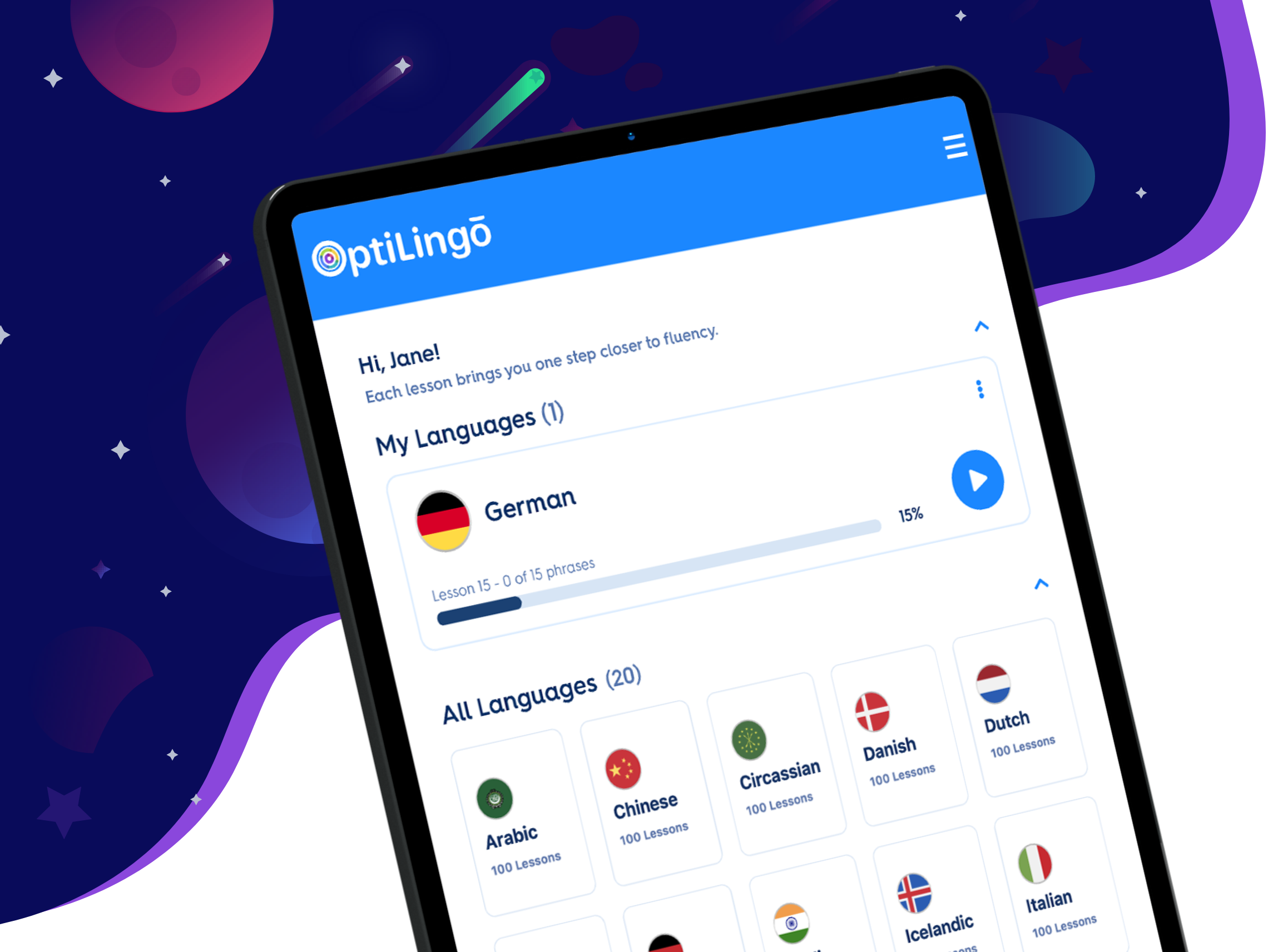
To reach German fluency easily, you need a reliable language learning method. One that introduces you to useful vocabulary, explains grammar, and makes you speak the language. And that’s exactly what OptiLingo is.
OptiLingo is the best app to learn German. It teaches you exactly how the locals speak. By giving you only the most useful and essential German phrases, you won’t waste time. Instead, your German knowledge will skyrocket, and you’ll reach fluency much faster than anyone else. Learn German with confidence when you download OptiLingo!