Written by Jonty Yamisha, Founder of OptiLingo and lifelong heritage-language learner
When I first started learning Korean numbers, I kept tripping over two things:
Why are there two number systems?
Why does 십육 suddenly sound like 심뉵 (sim-nyuk) when natives say it quickly?
If you are feeling the same, you are not alone.
The good news is that Korean numbers are very pattern-based. Once you understand those patterns, you can say ages, times, dates, prices, and phone numbers with confidence. Plus, you can learn the Korean alphabet in about 30 minutes.
In this guide you will learn:
- Both Korean number systems: Sino-Korean and Native-Korean
- How to count from 0 to large numbers
- How to say your age, tell time, read dates, and talk about money
- Pronunciation shortcuts that Koreans actually use
Want to hear and practice every number in real dialogues? Try OptiLingo free for 7 days and learn Korean through guided speaking practice.
How to Learn Korean Numbers
- Learn the two systems: Sino-Korean and Native-Korean
- Use Sino for dates, money, minutes, phone numbers
- Use Native for hours, age, and counting items
- 11 to 19 follow 십 + digit, for example 십일 (sip-il), 십육 (sip-yuk, said sim-nyuk)
- 20 to 90 follow 이십 (i-sip), 삼십 (sam-sip), 사십 (sa-sip) and so on
- Practical examples: 3시 30분 (se si samsip bun), 1999년 (cheon-gubaek-gusip-gu nyeon), 010-1234-5678 (gong-il-gong il-i-sam-sa o-yuk-chil-pal)
Table of Contents
- What You Will Learn
- The Two Korean Number Systems
- Sino-Korean Numbers
- Native-Korean Numbers
- How Numbers Work in Real Life
- Pronunciation Deep Dive
- Mini Practice
- What to Learn Next
- FAQs
1. What You Will Learn Today
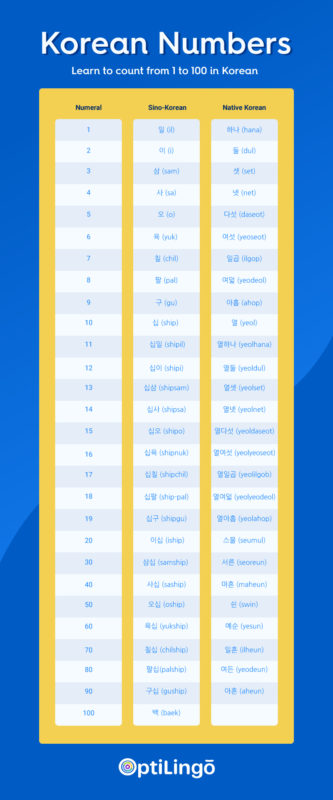
Korean has two different ways to say numbers. At first that feels like double the work. In reality, it is a shortcut, because each system has specific jobs. In fact, 60% of Korean vocabulary is Sino-Korean.
This guide shows you:
- Sino-Korean numbers from 0 to large numbers
- Native-Korean numbers from 1 to 99
- Clear rules for when to use each system
- Tables for money, time, dates, age, and counters
- Detailed pronunciation notes that keep you out of trouble
Korean is a really old language. My goal is that you can sit down with this article once, take a few notes, and walk away able to handle most everyday number situations in Korean.
2. The Two Korean Number Systems (At a Glance)
Korean uses two number systems. Think of them as two tools in one toolkit.
2.1 Overview Table
System |
Korean name |
Used for |
Examples |
Sino-Korean |
한자어 수 (han-ja-eo su) |
Dates, money, minutes, phone numbers, addresses, big numbers |
5,000원 (o-cheon won), 30분 (samsip bun), 1999년 (cheon-gubaek-gusip-gu nyeon) |
Native-Korean |
고유어 수 (go-yu-eo su) |
Hours, age, counting items with counters |
3시 (se si), 스무 살 (seumu sal), 두 개 (du gae) |
2.2 Why Two Systems? A Brief Cultural Note
Korea’s dual number system reflects centuries of Chinese cultural influence alongside the preservation of native Korean language. Sino-Korean numbers (한자어 수) came from Chinese characters (漢字, hanja) and were adopted for formal, written, and administrative purposes—think documents, money, and official records.
Native-Korean numbers (고유어 수) existed long before Chinese influence and stayed rooted in everyday life: counting objects, telling someone’s age, marking the hours. This wasn’t linguistic confusion—it was linguistic layering. Koreans kept their ancestral counting system for personal, human-centered activities while adopting Chinese numbers for the bureaucratic and commercial world.
Today, this separation actually makes the language more efficient. Each system signals context instantly: if you hear Native numbers, you know someone is talking about tangible, countable things or personal matters. Sino numbers mean you’re dealing with dates, money, or measurements.
2.3 Age and Modern Usage
Korea now mostly uses international age, just like the United States. You still express it with Native-Korean + 살 (sal):
- 20 years old: 스무 살 (seumu sal)
- 21 years old: 스물한 살 (seumul-han sal)
So the counting of years is “international”, but the language pattern for saying your age remains Korean.
3. Sino-Korean Numbers (Build Any Number)
Sino-Korean numbers are used whenever things feel “official” or written: dates, money, minutes, phone numbers, and large numbers.
3.1 Sino-Korean Numbers 0 to 10
Number |
Hangul |
Pronunciation |
Notes |
0 |
영 / 공 |
yeong / gong |
공 (gong) is common in phone numbers |
1 |
일 |
il |
Sounds like “eel” |
2 |
이 |
i |
Short “ee” sound |
3 |
삼 |
sam |
Like “sahm” |
4 |
사 |
sa |
Like “sah” |
5 |
오 |
o |
Like “oh” |
6 |
육 |
yuk |
Often sounds like “yook” or “ryook” in compounds |
7 |
칠 |
chil |
Like “chill” |
8 |
팔 |
pal |
Like “pahl” |
9 |
구 |
gu |
Like “goo” |
10 |
십 |
sip |
Like “ship” |
3.2 Numbers 11 to 19
Pattern: 십 (sip) + ones digit
Number |
Hangul |
Pronunciation |
Note |
11 |
십일 |
sip-il |
10 + 1, sounds like “shi-bil” |
12 |
십이 |
shi-bi |
10 + 2, liaison makes it flow |
15 |
십오 |
shi-bo |
10 + 5, the ㅂ flows into next syllable |
16 |
십육 |
sim-nyuk |
10 + 6, usually pronounced sim-nyuk in speech (ㅂ+ㄴ→ㅁㄴ) |
19 |
십구 |
sip-gu |
10 + 9, sounds like “ship-gu” |
Pronunciation note: When 십 (sip) comes before another syllable, the final ㅂ often sounds like it blends with the next consonant. Before ㄴ or ㄹ sounds, you’ll hear ㅁ instead of ㅂ.
3.3 Tens from 20 to 90
Pattern: [digit] + 십 (sip)
Number |
Hangul |
Pronunciation |
20 |
이십 |
i-sip (ee-ship) |
30 |
삼십 |
sam-sip (sahm-ship) |
40 |
사십 |
sa-sip (sah-ship) |
50 |
오십 |
o-sip (oh-ship) |
60 |
육십 |
yuk-sip (yook-ship) |
70 |
칠십 |
chil-sip (chill-ship) |
80 |
팔십 |
pal-sip (pahl-ship) |
90 |
구십 |
gu-sip (goo-ship) |
3.4 Numbers 21 to 99
Pattern: [tens] + [ones]
Number |
Hangul |
Pronunciation |
Explanation |
21 |
이십일 |
i-shi-bil |
20 + 1, liaison between 십 and 일 |
24 |
이십사 |
i-sip-sa |
20 + 4 |
37 |
삼십칠 |
sam-ship-chil |
30 + 7 |
58 |
오십팔 |
o-ship-pal |
50 + 8 |
99 |
구십구 |
gu-ship-gu |
90 + 9 |
Once you know the tens and the 1 to 9 digits, you can build any number from 11 to 99.
3.5 Large Units
Korean uses special words for large units.
Unit value |
Hangul |
Pronunciation |
Example number |
Hangul |
Pronunciation |
100 |
백 |
baek |
104 |
백사 |
baek-sa |
1,000 |
천 |
cheon |
3,500 |
삼천오백 |
sam-cheon-o-baek |
10,000 |
만 |
man |
20,000 |
이만 |
i-man (ee-mahn) |
100,000,000 |
억 |
eok |
2,000,000 |
이백만 |
i-baek-man |
Note: 만 (man, 10,000) is particularly important in Korean. Where English groups by thousands (1,000, 1,000,000), Korean groups by ten-thousands. So 50,000 is 오만 (o-man, literally “five ten-thousands”), not “fifty thousand.”
You stack them logically. For example, 3,500 (sam-cheon-o-baek) is literally “three thousand five hundred” in order.
3.6 Mini Drill: Sino-Korean
Read and say these numbers:
Arabic number |
Hangul |
Pronunciation |
37 |
삼십칠 |
sam-ship-chil |
58 |
오십팔 |
o-ship-pal |
104 |
백사 |
baek-sa |
3,500 |
삼천오백 |
sam-cheon-o-baek |
20,000 |
이만 |
i-man |
Say each one slowly, then a bit more naturally. This is exactly what you will see in prices and large amounts.
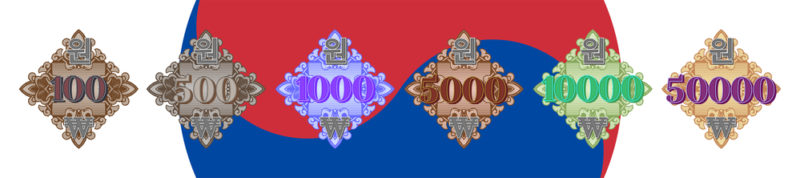
4. Native-Korean Numbers (1 to 99 Focus)
Native-Korean numbers are used for hours, age, and counting with counters.
4.1 Native Numbers 1 to 10
Some numbers change form before counters, which is shown in the table.
Number |
Basic form |
Before counters |
Pronunciation (basic / counter form) |
1 |
하나 |
한 |
hana / han (hah-nah / hahn) |
2 |
둘 |
두 |
dul / du (dool / doo) |
3 |
셋 |
세 |
set / se (set / seh) |
4 |
넷 |
네 |
net / ne (net / neh) |
5 |
다섯 |
– |
daseot (dah-suht) |
6 |
여섯 |
– |
yeoseot (yuh-suht) |
7 |
일곱 |
– |
ilgop (eel-gop) |
8 |
여덟 |
– |
yeodeol (yuh-duhl) |
9 |
아홉 |
– |
ahop (ah-hop) |
10 |
열 |
– |
yeol (yuhl) |
Important pronunciation notes:
- ㅅ (s) disappears: When 하나, 둘, 셋, 넷 come before counters, they drop their final consonant and become 한, 두, 세, 네
- ㅓ sound: The ㅓ in 여섯, 여덟 sounds like “uh” in “sun”
- Final consonants: 일곱 ends with a ㅂ+ㅅ cluster that sounds like a soft “p” sound
4.2 Native Decades 20 to 90
Number |
Hangul |
Pronunciation |
Note |
20 |
스물 |
seumul |
Becomes 스무 (seumu) before 살 (sal) for age |
30 |
서른 |
seoreun (suh-reun) |
|
40 |
마흔 |
maheun (mah-heun) |
|
50 |
쉰 |
swin |
Short, one syllable |
60 |
예순 |
yesun (yeh-soon) |
|
70 |
일흔 |
ilheun (eel-heun) |
|
80 |
여든 |
yeodeun (yuh-deun) |
|
90 |
아흔 |
aheun (ah-heun) |
Pattern note: Native numbers from 21-29, 31-39, etc. combine the decade with the basic form: 스물하나 (seumul-hana, 21), 서른둘 (seoreun-dul, 32).
4.3 Native Numbers with Common Counters
Task |
Pattern |
Example (Hangul) |
Pronunciation |
Meaning |
Counting things |
Native + 개 (gae) |
한 개, 두 개, 세 개 |
han gae, du gae, se gae |
1, 2, 3 things |
People |
Native + 명 (myeong) |
한 명, 두 명 |
han myeong, du myeong |
1, 2 people |
Cups or glasses |
Native + 잔 (jan) |
두 잔 |
du jan |
2 drinks |
Books |
Native + 권 (gwon) |
네 권 |
ne gwon |
4 books |
Hours |
Native + 시 (si) |
세 시 |
se si |
3 o’clock |
Minutes |
Sino + 분 (bun) |
삼십 분 |
sam-ship bun |
30 minutes |
Age |
Native + 살 (sal) |
스무 살, 스물한 살 |
seumu sal, seumul-han sal |
20, 21 years old |
4.4 Mini Drill: Native-Korean
Say these out loud.
Prompt |
Korean |
Pronunciation |
3 items |
세 개 |
se gae |
2 drinks |
두 잔 |
du jan |
1 person |
한 명 |
han myeong |
3 o’clock |
세 시 |
se si |
20 years old |
스무 살 |
seumu sal |
21 years old |
스물한 살 |
seumul-han sal |
5. Using Numbers in Real Life
Now you will connect the two systems to real situations.
5.1 Time: Hours and Minutes
Hours use Native-Korean + 시 (si). Minutes use Sino-Korean + 분 (bun).
Meaning |
Korean |
Pronunciation |
3 o’clock |
세 시 |
se si |
7 o’clock |
일곱 시 |
ilgop si |
30 minutes |
삼십 분 |
sam-ship bun |
7:30 |
일곱 시 삼십 분 |
ilgop si sam-ship bun |
For more detail on time, see our guide on how to tell time in Korean.
5.2 Dates
Dates use Sino-Korean numbers.
Part |
Marker |
Example |
Pronunciation |
Meaning |
Year |
년 (nyeon) |
1999년 |
cheon-gubaek-gusip-gu nyeon |
year 1999 |
Month |
월 (wol) |
3월 |
sam wol |
March |
Day |
일 (il) |
5일 |
o il |
5th |
Full date |
– |
1999년 3월 5일 |
cheon-gubaek-gusip-gu nyeon sam wol o il |
March 5, 1999 |
You can practice more in our article on Korean dates and months.
5.3 Money and Prices
Money uses Sino-Korean numbers + 원 (won).
Amount |
Hangul |
Pronunciation |
5,000원 |
오천원 |
o-cheon won |
12,000원 |
만이천원 |
man-i-cheon won |
500원 |
오백원 |
o-baek won |
See our guide on prices in Korean for more examples.
5.4 Phone Numbers
Phone numbers are read digit by digit using Sino-Korean numbers. 0 is usually 공 (gong).
Number |
Korean reading |
Pronunciation |
010-1234-5678 |
공일공-일이삼사-오육칠팔 |
gong-il-gong il-i-sam-sa o-yuk-chil-pal |
Pronunciation tip: Phone numbers are spoken in a steady rhythm with slight pauses at the hyphens. Each digit is clear and distinct—no liaison or blending happens here.
5.5 Counting Things with Counters
You will use Native-Korean + counter.
Meaning |
Korean |
Pronunciation |
1 thing |
한 개 |
han gae |
2 things |
두 개 |
du gae |
3 people |
세 명 |
se myeong |
2 cups of coffee |
커피 두 잔 |
keopi du jan |
5.6 Saying Age
Age uses Native-Korean + 살 (sal).
Meaning |
Korean |
Pronunciation |
20 years old |
스무 살 |
seumu sal |
21 years old |
스물한 살 |
seumul-han sal |
30 years old |
서른 살 |
seoreun sal |
6. Pronunciation Deep Dive
You do not need to master all phonology. You just need to know the most common patterns that affect how numbers actually sound in conversation.
6.1 The 십육 → 심뉵 Phenomenon (Nasal Assimilation)
When ㅂ (b/p sound) at the end of one syllable meets ㄴ or ㄹ at the start of the next, the ㅂ becomes ㅁ (m sound). This is called nasal assimilation (비음화, bi-eum-hwa).
Examples:
- 십육 (sip-yuk) → 심뉵 (sim-nyuk) — the ㅂ becomes ㅁ before ㄴ
- 십년 (sip-nyeon) → 심년 (sim-nyeon)
- 십리 (sip-ri) → 심니 (sim-ni)
You’ll see 십육 written in Hangul, but natives will always say 심뉵. This isn’t sloppy speech—it’s how Korean phonology naturally works.
6.2 Liaison (연음, yeon-eum)
When a syllable ends with a consonant and the next syllable starts with a vowel (like ㅇ), the final consonant “moves” to the next syllable.
Examples:
- 십일 (sip-il) → sounds like 시빌 (shi-bil)
- 십오 (sip-o) → sounds like 시보 (shi-bo)
- 삼십오 (samsip-o) → sounds like 삼시보 (sam-shi-bo)
- 이십일 (i-sip-il) → sounds like 이시빌 (i-shi-bil)
This is why spoken Korean sounds so fluid. The written boundaries between syllables don’t always match the spoken ones.
6.3 The Tricky 육 (yuk/ryuk)
육 (six) has variable pronunciation depending on what comes before or after it:
- Standalone or at the beginning: 육 (yuk)
- After ㄴ or ㄹ sounds: often becomes 륙 (ryuk)
- 십육 → 심뉵 (sim-nyuk) — the ㄴ triggers both nasal assimilation AND makes 육 sound like 뉵
- 백육십 → 뱅뉵십 (baeng-nyuk-ship)
Don’t worry about producing this perfectly at first. Just be aware that you’ll hear 육 pronounced different ways.
6.4 Final Consonant Neutralization
Korean has seven possible final consonant sounds, but they’re all pronounced as one of these: ㄱ, ㄴ, ㄷ, ㄹ, ㅁ, ㅂ, ㅇ. This affects how number words sound:
- 여덟 (eight) ends with ㄼ, but sounds like 여덜 (yeodeol) with a ㄹ sound
- 일곱 (seven) ends with ㅂ sound (from ㄼ cluster)
6.5 Common Pronunciation Traps: Summary Table
Topic |
Korean example |
Written pronunciation |
Actual spoken sound |
What is happening |
Nasal assimilation |
십육 |
sip-yuk |
sim-nyuk |
ㅂ + ㄴ → ㅁㄴ |
Nasal assimilation |
십년 |
sip-nyeon |
sim-nyeon |
ㅂ + ㄴ → ㅁㄴ |
Liaison |
십일 |
sip-il |
shi-bil |
ㅂ moves to next syllable |
Liaison |
삼십오 |
sam-sip-o |
sam-shi-bo |
ㅂ moves to next syllable |
육 variations |
육십 |
yuk-sip |
yuk-sip or ryuk-sip |
Context-dependent |
Age spacing |
스무 살 |
seumu sal |
seumu sal |
Not 스물 살 in this phrase |
System mix |
3시 30분 |
se si samsip bun |
se si sam-ship bun |
Native for 시, Sino for 분 |
6.6 Tips for Natural Pronunciation
Listen actively: When you hear native speakers say numbers, pay attention to where they blend sounds or where pronunciation differs from spelling.
Start slow, then speed up: Practice saying 십육 as “sip-yuk” slowly, then gradually speed up until it naturally becomes “sim-nyuk.”
Don’t over-correct yourself: If you say “sip-yuk” clearly, Koreans will understand you perfectly. These pronunciation shifts happen naturally as you get more comfortable.
Record yourself: Say a sequence like 십일, 십이, 십삼, 십사, 십오, 십육 and listen back. You’ll start to hear where the sounds naturally want to blend.
7. Mini Practice: Read, Say, Write
Try these six prompts to lock in the patterns. Say both Hangul and pronunciation out loud.
Prompt |
Korean |
Pronunciation |
Read this duration |
24분 |
i-ship-sa bun (ee-ship-sah boon) |
Say this time |
7시 30분 |
ilgop si sam-ship bun (eel-gop shee sahm-ship boon) |
Count items |
3개 |
se gae (seh geh) |
Read this year |
1999년 |
cheon-gubaek-gusip-gu nyeon (chun-goo-beck-goo-ship-goo nyuhn) |
Say this phone number |
010-1234-5678 |
gong-il-gong il-i-sam-sa o-yuk-chil-pal |
Say this age |
20 years old |
seumu sal (seuh-moo sahl) |
Doing this out loud, even once or twice, makes a huge difference. This is the core of how OptiLingo teaches numbers inside real dialogues.
8. What to Learn Next
Now you know:
- Sino-Korean numbers and how to build any number you need
- Native-Korean numbers for counting, hours, and age
- Which system to use for dates, time, money, and phone numbers
- The most common pronunciation patterns and why they happen
- The cultural history behind Korea’s dual number system
Next, you can deepen your skills with:
- A full Korean pronunciation guide
- A detailed article on counters in Korean
- A step by step breakdown of how to tell time in Korean
- A walkthrough of Korean dates and months
- An overview of prices in Korean and money expressions
- Our broader library of learn Korean resources
Ready to use Korean numbers in real life conversations and listening practice? Start your 7 day free trial of OptiLingo and practice these numbers inside guided lessons.
FAQs
1) Why are there two number systems in Korean?
Korean uses Sino-Korean numbers (한자어 수, han-ja-eo su) that came from Chinese and Native-Korean numbers (고유어 수, go-yu-eo su) that developed inside Korean. The dual system reflects Korea’s history of Chinese cultural influence while maintaining its native language. Sino-Korean numbers were adopted for formal, administrative, and commercial purposes (dates, money, addresses), while Native-Korean numbers stayed rooted in everyday life (counting objects, telling age, marking hours). This separation actually makes the language more efficient—each system signals context immediately.
2) When do I use Native vs Sino numbers?
Use Native-Korean numbers for:
- Hours (시)
- Age (살)
- Counting items with counters (개, 명, 잔, 권, etc.)
Use Sino-Korean numbers for:
- Minutes (분)
- Dates, years (년, 월, 일)
- Money (원)
- Phone numbers
- Addresses
- Large numbers and quantities
3) How do I say my age in Korean?
Use Native-Korean + 살 (sal).
- 20 years old: 스무 살 (seumu sal)
- 21 years old: 스물한 살 (seumul-han sal)
- 30 years old: 서른 살 (seoreun sal)
Note: 20 is 스물 (seumul) normally, but becomes 스무 (seumu) before 살.
4) How do I read time and dates?
Time:
- Hours: Native + 시 (si), for example 세 시 (se si) for 3 o’clock
- Minutes: Sino + 분 (bun), for example 삼십 분 (sam-ship bun) for 30 minutes
Date:
- Year: Sino + 년 (nyeon)
- Month: Sino + 월 (wol)
- Day: Sino + 일 (il)
Example: 1999년 3월 5일 → 천구백구십구 년 삼월 오일 (cheon-gubaek-gusip-gu nyeon sam wol o il)
5) What is going on with pronunciations like 십육 → 심뉵?
This is called nasal assimilation (비음화). When the final ㅂ sound in 십 meets the ㄴ sound in 육, the ㅂ naturally becomes ㅁ to make pronunciation smoother. So 십육 (sip-yuk) becomes 심뉵 (sim-nyuk) in actual speech. You don’t need to write it that way, but you will hear it from native speakers. This same pattern happens with 십년 (sim-nyeon), 십리 (sim-ni), and other similar combinations.
6) Why does 만 (10,000) matter so much?
Korean groups numbers by ten-thousands (만) rather than thousands like English. This affects how you think about and say large numbers:
- 50,000 is 오만 (o-man, “five ten-thousands”), not “fifty thousand”
- 100,000 is 십만 (sip-man, “ten ten-thousands”)
- 1,000,000 is 백만 (baek-man, “one hundred ten-thousands”)
Once you internalize the 만 unit, Korean large numbers actually become easier than English ones.
As difficult as this counting system may seem to English native speakers, it’s not impossible to learn. Korean numbers are a great example of how unique and beautiful this language is. And you can learn it easily with OptiLingo.
OptiLingo offers scientifically proven language learning methods to get you to fluency fast. By using comprehensible input and spaced repetition, you can learn Korean numbers effectively. And the stress-free environment of the app ensures that you can learn at your own pace. Have fun and master speaking a new language with OptiLingo!